


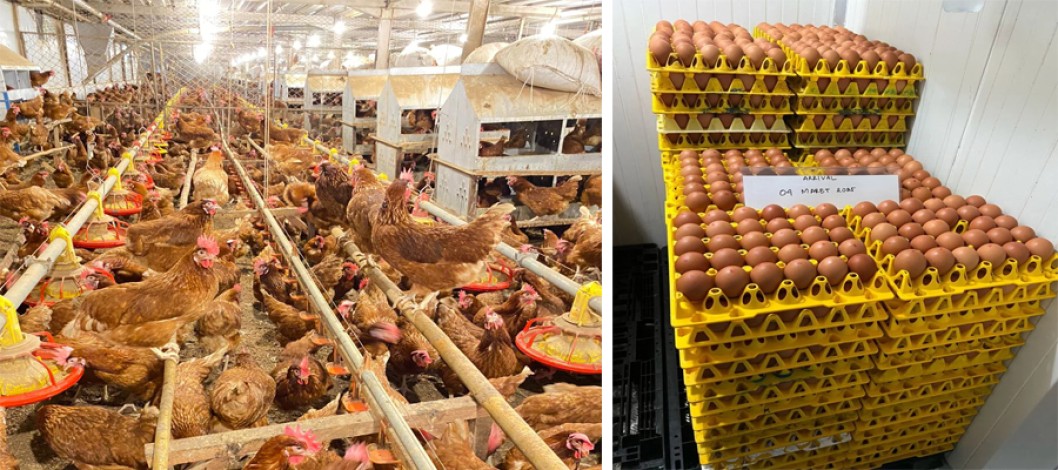
Jakarta – Consumer awareness of food products that are not only safe and nutritious but also produced with higher animal welfare standards has continued to grow in recent years. Alongside this trend, demand for cage-free eggs has shown consistent growth, encouraging more egg producers to explore transitioning to or expanding cage-free production systems. Among the most progressive companies is PT Widodo Makmur Unggas Tbk (WMU), whose expansion plans could position the company as the largest cage-free egg producer in Southeast Asia.
According to Tri Mahawijaya Herlambang, Marketing Director of WMU, the market for cage-free eggs in Indonesia continues to expand. He noted that growth is being driven not only by multinational food companies but also by a growing number of domestic businesses and local companies that are beginning to source cage-free eggs.
To meet the needs of this growing market, WMU is gradually expanding its cage-free egg production capacity from its current flock of approximately 200,000 laying hens to 500,000 birds, with completion targeted by 2027. We are confident that demand for cage-free eggs will continue to increase. Therefore, we are building production capacity now to ensure we are prepared to respond to future demand growth,” said Mahawijaya in Jakarta on Friday (June 19, 2026).
Currently, WMU markets its cage-free eggs through a business-to-business (B2B) model, serving a wide range of customers including catering companies, hotel chains, restaurants, and quick-service restaurant operators. The company is also preparing to launch its own cage-free egg brand for the retail market.
“This expansion is not intended to replace existing markets, but rather to create a new, higher-value segment while responding to increasing consumer interest in sustainability, food safety, and animal welfare. As a publicly listed company, WMU is also committed to sustainability. Implementing animal welfare practices through cage-free farming is one tangible example of that commitment,” he added.
Responding to the expansion plan, Sandi Dwiyanto, Sustainable Poultry Program Manager at Lever Foundation, expressed appreciation for WMU’s efforts to increase cage-free production capacity in Indonesia. According to him, growing commitments from both consumers and businesses toward sustainability and food quality are creating significant opportunities for the cage-free egg sector.
“Over the past several years, demand for cage-free eggs has continued to grow, particularly from the retail, hospitality, restaurant, FMCG, and foodservice sectors. Today, more than 2,000 food companies worldwide have committed to sourcing 100 percent cage-free eggs, including major international brands operating in Indonesia such as KFC, Burger King, Hyatt, Marriott, and Swiss-Belhotel International. At the same time, an increasing number of domestic companies are adopting or transitioning toward cage-free egg sourcing policies, including Super Indo, Ismaya Group, Bali Buda, Jiwa Jawi, and many others,” said Sandi.
The growth of cage-free products is also reflected in consumer research conducted by GMO Research, a Japanese market research and consumer panel company. The survey found that 55 percent of Indonesian consumers prefer purchasing products from brands that exclusively use cage-free eggs. Additionally, 72 percent of respondents agreed that eggs used by food companies should come from farms that implement animal welfare standards. Beyond market demand, cage-free production is also increasingly associated with food safety benefits. A multi-country study conducted by the European Food Safety Authority (EFSA) found that cage-free egg farms have up to 25 times lower risk of contamination from certain strains of Salmonella bacteria compared to conventional cage systems.
“In addition to being driven by market demand and product quality considerations, WMU’s expansion is also aligned with the issuance of Indonesia’s Minister of Agriculture Regulation No. 32 of 2025 on Animal Welfare Implementation. We hope WMU’s leadership will inspire more egg producers across Indonesia to prepare for evolving market expectations. Lever Foundation remains committed to supporting the development of Indonesia’s cage-free ecosystem to ensure that growing market demand is matched by a reliable and sustainable supply,” Sandi concluded.
You can learn about South Asia's
largest exhibition on this topic through this link: https://dpexpobd.com/
Source: Email/GFMM










Comment Now