




Many industrial project buyers face a key dilemma when selecting lifting equipment: how do you choose between a gantry crane and an overhead crane?
This article breaks down the core differences between the two cranes from five aspects: structural design, application scenarios, environmental adaptability, cost and maintenance, and selection guidelines. It will help you choose the most cost-effective lifting solution based on your project’s actual needs.
1. Core Structural Differences: The Leg Design Is the Most Obvious Distinction
The biggest difference between an overhead crane and a gantry crane lies in their support method and installation carrier — the root of all other differences.
Overhead Crane
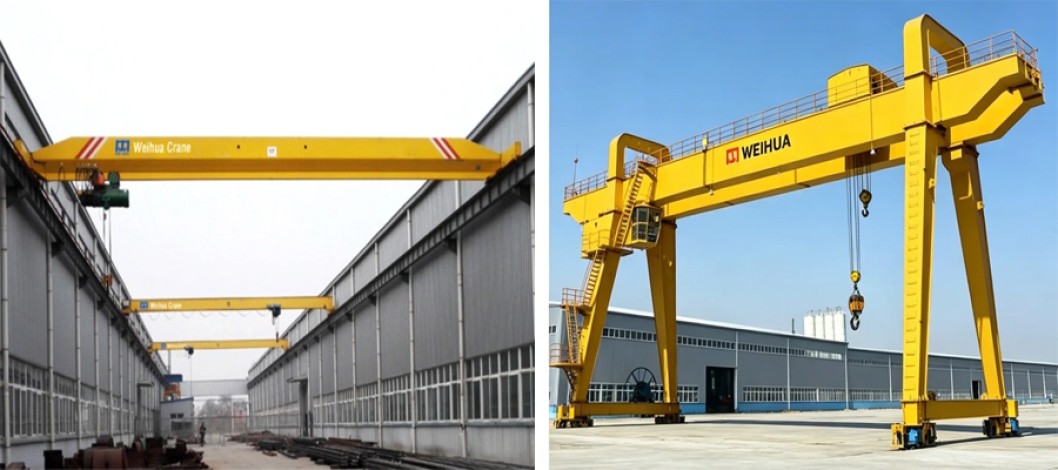
An overhead crane is a building-dependent piece of equipment with no ground legs. Its main beam spans across the overhead load-bearing beams and column rails on both sides of the factory, suspended entirely in the air. It relies on the factory’s steel structure or concrete columns to bear the full load. The crane travels back and forth on fixed overhead rails, occupying no ground space at all, making it a dedicated indoor lifting device.
Gantry Crane
A gantry crane can be seen as a modified version of the overhead crane. It has two vertical steel legs that form a stable gantry frame. The entire machine stands on its legs and runs on ground-mounted rails. It does not rely on the factory building and can operate independently, free from structural limitations, offering greater flexibility.
2. Application Scenarios: Indoor Precision Work vs. Outdoor Large-Scale Operations
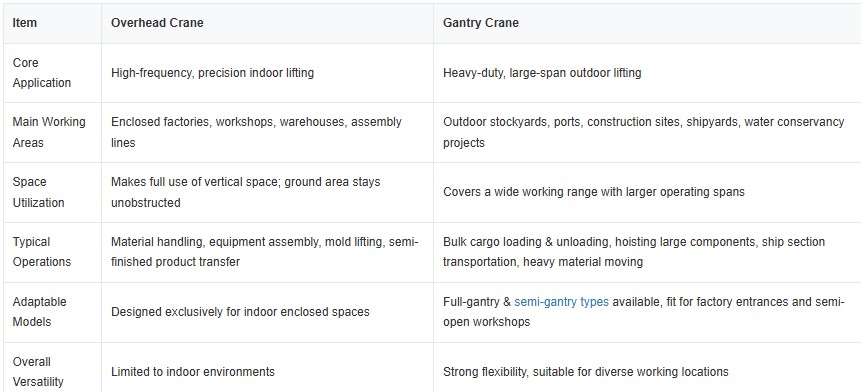
These structural differences directly determine the core use cases of each crane, which is the key basis for purchasing decisions.
See more.
Source: Online/GFMM






















Comment Now