



-By
Grain Feed & Milling Magazine
The
last decade has arguably been the most transformative period in modern grain
milling since the widespread adoption of pneumatic conveying, roller milling
and automatic process control.
Between
2016 and 2026, the world's leading milling technology suppliers moved beyond
simply developing faster or larger machines. The focus shifted toward intelligent
equipment, real-time sensors, automation, artificial intelligence, energy
efficiency, food safety, predictive maintenance and connected production
systems.
The
modern mill is increasingly becoming a data-driven manufacturing facility in
which machines communicate with one another, process parameters are
continuously measured, and software helps operators make decisions—or, in some
cases, makes those decisions automatically.
From
Bühler's SmartMill concept and Mill E3 to Alapala's new-generation Similago II,
Satake's advanced optical sorting and Henry Simon's sensor-equipped milling
machinery, the decade has produced a new generation of technologies that are
reshaping flour, rice, maize and other grain-processing operations.
Here
are 10 of the most important milling technology developments of 2016–2026.
1. Smart Milling and Autonomous Process Optimization
The
most important development of the decade is arguably not a single machine but
the emergence of the Smart Mill.
Industry
4.0 has introduced sensors, connectivity, cloud computing, analytics and
artificial intelligence into milling. Bühler's SmartMill concept illustrates
this transition particularly clearly. Its development moves through four
stages: Connect, Monitor, Assist and Self-optimize. The ultimate
objective is a mill capable of using real-time data to optimize production with
progressively less human intervention.
The
significance is enormous.
Traditional
automation primarily instructed machines to perform predefined tasks. Smart
milling adds another layer: the system collects data about raw materials,
machine conditions and production results, analyzes those data and uses the
information to improve the process.
Modern
digital systems can monitor parameters such as:
This
creates the foundation for predictive maintenance, yield optimization and eventually
closed-loop process control.
The fully autonomous mill is still an evolving target rather than a universal reality. However, the direction of travel is unmistakable: from automated machines to intelligent, interconnected milling systems.
2. Integrated High-Efficiency Grinding Systems
The
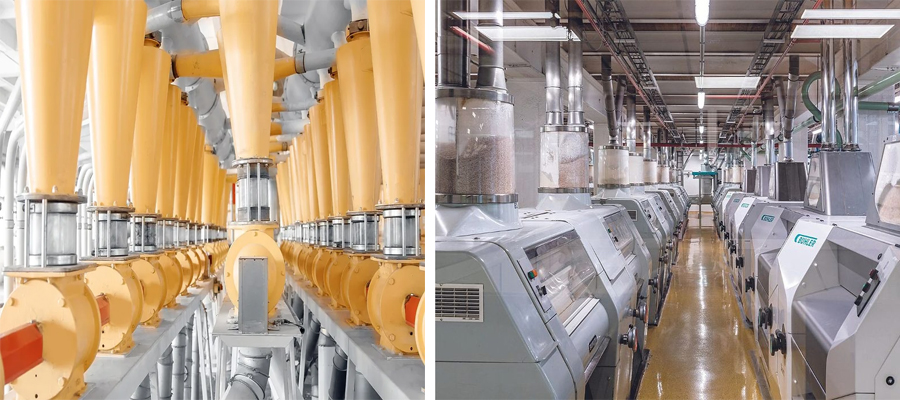
roller mill remains at the heart of conventional flour milling, but its design
has changed substantially.
One
of the decade's notable developments is the move toward integrated grinding
systems that combine feeding, grinding, drive technology, monitoring and
control into a more compact package.
Bühler's
Arrius integrated grinding system, for example, uses a self-regulating
feeding module, integrated drive and multiple sensors. Bühler states that its integrated
drive can reduce energy consumption by up to 10% compared with conventional
roller-mill arrangements, while sensors continuously monitor operating
conditions.
This
approach changes the philosophy of grinding equipment.
Instead
of optimizing the roller mill as an isolated machine, manufacturers are
increasingly optimizing the complete grinding unit. Better feed distribution,
improved grinding stability, integrated drives and real-time monitoring can
contribute to more consistent performance.
For
millers, the potential benefits include:
better
grinding stability + lower energy consumption + reduced maintenance + improved
process control.
3. Mill E3 and the Compact Modular Mill Concept
The
introduction of Mill E3 represented another major change in flour-mill
engineering.
Bühler
introduced Mill E3 in 2019 as a new approach to plant design, combining modular
construction, new process technologies, digitalization and energy-saving
solutions. According to Bühler, the concept can reduce building volume by up to
30%, accelerate installation by up to 30% and reduce energy consumption by up
to 10%.
The
importance of Mill E3 goes beyond those individual numbers.
For
decades, large flour mills were associated with tall multi-storey buildings and
extensive pneumatic transport systems. The modular approach challenged that
conventional plant architecture.
Preassembled
modules can simplify installation and commissioning, while compact layouts can
reduce construction requirements.
The
concept demonstrates a broader trend in the industry:
the
mill is increasingly being engineered as an integrated system rather than as a
collection of individual machines.
This
is particularly important in markets where construction costs, installation
time, energy consumption and available land are major investment
considerations.
4. AI and Advanced Optical Sorting
Optical
sorting has evolved dramatically during the last decade.
Modern
sorters can use high-resolution cameras, RGB imaging, infrared and other spectral
technologies to identify defective grains and foreign materials that
conventional mechanical cleaning systems cannot reliably distinguish.
Satake's
optical sorting platforms demonstrate this progression. Its EVOLUTION sorter
combines full-colour RGB imaging with shape recognition and multi-wavelength
infrared technology.
More
recent systems are adding another important capability: automatic defect
profiling and sensitivity adjustment.
Satake's
2026 SLASH β PLUS, for example, incorporates automatic sensitivity setting and
high-speed ejectors designed to improve sorting performance while reducing
acceptable product being rejected.
In
October 2026, Satake also announced its CHT16A high-capacity optical sorter for
grain and seed processing, featuring automatic sensitivity creation and
advanced shape sorting. The company says the machine is designed for throughput
exceeding 30 tonnes per hour for long-grain rice, depending on material
conditions.
For
the milling industry, the importance of optical sorting extends beyond
appearance.
It
contributes to:
The
next stage is increasingly about AI-assisted decisions rather than simply
camera-based sorting.
5. Sensor-Based Roller-Mill Control
One
of the quietest but most important developments of the decade has been the
proliferation of sensors throughout milling machinery.
Alapala's
Similago II is a good example. Its feed-roll speed is automatically
controlled according to product level, while PLC-based controls monitor feeding
and machine operation. The machine also incorporates motor-load protection,
roll-speed monitoring and a roll-disengagement system.
Henry
Simon has followed a similar direction with its HSRM Roller Mill.
The
HSRM uses Advanced Sensor Technology to track machine status in real time and
record data related to optimum operating conditions. Its sensor options include
motor-load, stock-level, feed-roll rotation and temperature monitoring.
This
represents an important change in milling philosophy.
Previously,
experienced millers often relied heavily on physical observation, sound,
vibration and manual adjustment. Modern sensor systems do not eliminate the
miller's expertise; instead, they convert machine conditions into measurable
information.
The
result is better visibility, faster fault detection and more consistent
operating conditions.
6. Digital Process Control, SCADA and MES
The
modern mill increasingly has a digital nervous system.
Centralized
PLCs, SCADA systems, production dashboards, MES platforms and cloud-based
services allow managers to see what is happening across the plant in real time.
Alapala
projects, for example, have combined advanced automation with SCADA software to
provide centralized monitoring, process control, traceability and production
reporting.
Ocrim
has taken Industry 4.0 integration even further in large turnkey projects. Its
660-tonne-per-day-per-line Universal Robina project in the Philippines was
designed for automated control from grain cleaning through flour packing and
palletizing.
This
is important because a mill can no longer be viewed simply as a grinding plant.
A
digital system can connect:
grain
intake → cleaning → conditioning → milling → sifting → blending → storage →
packing → dispatch.
Once
information from these stages is connected, managers can analyze the entire
production chain rather than individual machines.
7. Advanced Grain Cleaning and Food-Safety Technology
The
milling industry has also made major progress in the front end of the process.
Modern
cleaning systems increasingly combine mechanical separation with optical and
sensor-based technologies.
The
objective is not merely to remove stones, dust and large foreign materials.
Modern plants must also address damaged kernels, abnormal grains, contaminants
and potential food-safety risks.
Ocrim's
recent turnkey projects emphasize High Efficiency Cleaning, sanitation,
traceability and the removal of impurities and potentially mycotoxin-infected
grains.
Alapala
has similarly incorporated colour sorting technology into modern flour-mill
projects to separate foreign seeds and damaged or partially damaged kernels
using software and RGB cameras.
At
the same time, hygienic machine design has become increasingly important.
Stainless-steel
product-contact surfaces, residue reduction, easier access for cleaning and
reduced contamination risks are becoming integral elements of modern milling
machinery.
8. Energy-Efficient Conveying and Plant Design
Energy
efficiency has moved from being an engineering preference to a strategic
necessity.
Grinding
is energy-intensive, but significant energy is also consumed by pneumatic
conveying, aspiration, fans, compressors and auxiliary systems.
Modern
plant designers therefore increasingly look at the energy consumption of the whole
process.
Bühler's
Mill E3, for example, uses a hybrid transport concept incorporating its TUBO
tubular push conveyor alongside pneumatic transport. The company states that
this can reduce conveying energy and contribute to overall plant efficiency.
Ocrim's
High Efficiency Flow concept similarly focuses on improving extraction while
optimizing energy consumption. Its recent URC project was designed around
sustainability, energy efficiency, food safety and Industry 4.0 automation.
The
next generation of mills will increasingly be judged not only by tonnes per
hour but by:
kilowatt-hours
per tonne + extraction rate + product quality.
9. Predictive Maintenance and Condition Monitoring
Unplanned
downtime can be extremely expensive in a continuous milling operation.
The
introduction of temperature, vibration, motor-load and other condition sensors
has therefore created a new approach to maintenance: predictive rather than
purely preventive maintenance.
Bühler's
SmartMill development includes machine-condition monitoring as well as
temperature and vibration management. These systems use real-time information
to identify changes in machine behaviour and support more stable operation.
Henry
Simon's sensor-equipped machinery also provides real-time machine-status
monitoring and data recording.
Instead
of waiting for a component to fail—or replacing it strictly according to a
calendar—operators can increasingly use actual machine-condition information to
determine when intervention is required.
This
can reduce:
10. Intelligent Rice and Specialty Grain Milling
The
technological revolution has not been limited to wheat flour. Rice milling,
maize processing and other grain applications have benefited enormously from
advances in precision processing and optical sorting.
Satake's
recent rice-milling technology demonstrates the continuing emphasis on yield,
gentle processing and quality preservation. Its SSW series uses uniform
internal-pressure milling technology designed to improve efficiency and
head-rice yield. The SSW80A, introduced in 2026, expands the series to an
8-tonne-per-hour capacity class.
Meanwhile,
modern optical systems can combine colour, shape and near-infrared information
to identify defects and foreign materials.
The
broader lesson is significant: the future of milling technology is not a single
universal machine. Instead, equipment is becoming increasingly specialized
while remaining connected through digital control systems.
The Major Players Shaping the Decade
Several
international technology companies have played important roles in this
transformation.
Bühler
Bühler has been particularly
influential in pushing the industry toward integrated grinding, modular mill
architecture and digitalization. Mill E3, Arrius and SmartMill represent
three important dimensions of this evolution: plant efficiency, grinding
efficiency and digital intelligence.
Alapala
Alapala has continued to develop
complete grain-milling solutions and modern roller-mill technology. The Similago
II combines automatic feeding control, monitoring and sanitation-focused
design, while the company's turnkey projects increasingly incorporate
centralized automation and optical sorting.
Satake
Satake remains particularly
important in rice processing and optical sorting. Its development of RGB,
shape-recognition and multi-wavelength infrared technologies demonstrates how
machine vision has become central to modern grain quality control.
Ocrim
Ocrim has emphasized integrated
turnkey plants, Industry 4.0 automation, High Efficiency Flow, energy
efficiency, sanitation and traceability. Its recent large-scale projects
demonstrate how complete mills are being designed around digital and
sustainability principles from the beginning.
Henry
Simon
The Henry Simon brand, supported by
the Satake–Alapala partnership, has brought sensor-based intelligent equipment
into modern flour milling. Its HSRM roller mill and associated milling
equipment emphasize machine monitoring, process control and operational safety.
You
can learn about South Asia's largest exhibition on the agricultural topic
through this link: http://graintechbd.com/
-SZK










Comment Now