



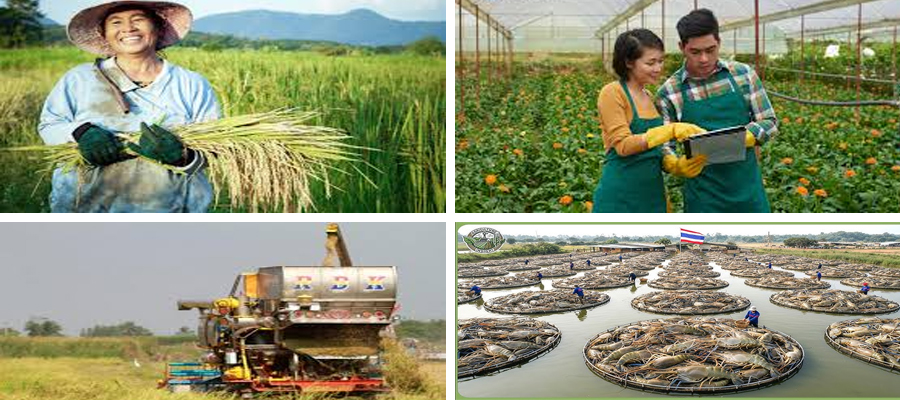
Agriculture in Thailand is highly competitive, diversified and specialized and its exports are very successful internationally. Rice is the country's most important crop, with some 60 percent of Thailand's 13 million farmers growing it on almost half of Thailand's cultivated land. Thailand is a major exporter in the world rice market. Rice exports in 2014 amounted to 1.3 percent of GDP. Agricultural production as a whole accounts for an estimated 9–10.5 percent of Thai GDP. Forty percent of the population work in agriculture-related jobs. The farmland they work was valued at US$2,945/rai ($18,410/ha; $7,450/acre) in 2013. 9 Most Thai farmers own fewer than eight ha (50 rai) of land.
Other agricultural commodities produced in significant amounts include fish and fishery products, tapioca, rubber, grain, and sugar. Exports of industrially processed foods such as canned tuna, pineapples, and frozen shrimp are on the rise.
After the Neolithic Revolution, the societal structure in the region transitioned from hunting and gathering to agro-cities, eventually leading to state-religious empires. Since around 1000 CE, the cultivation of Tai wet glutinous rice has been a pivotal aspect of the local administrative structures, reflecting the pragmatic nature of a society that consistently produced a surplus suitable for trade. This agricultural system, which remains significant, underscores the ongoing importance of rice agriculture for Thailand's national security and economic prosperity.
Since the 1960s, agricultural advancements have significantly impacted employment and living standards in Thailand. Unemployment has decreased markedly, dropping from over 60 percent to under 10 percent in the early 2000s.[8] Concurrently, there has been a notable reduction in food prices and hunger rates. For instance, the number of households experiencing hunger dropped from 2.55 million in 1988 to 418,000 in 2007. Additionally, child malnutrition rates declined from 17 percent in 1987 to seven percent in 2006. These improvements have been attributed to a combination of strong state involvement in investment in infrastructure, education, and access to credit, as well as successful private initiatives in the agribusiness sector. This comprehensive approach has facilitated Thailand's evolution into an industrialized economy.
Agriculture expanded during the 1960s and 1970s as it had access to new land and unemployed labour. Between 1962 and 1983, the agricultural sector grew by 4.1 percent a year on average and in 1980 it employed over 70 percent of the working population.[8] Yet, the state perceived developments in the agricultural sector as necessary for industrialisation and exports were taxed to keep domestic prices low and raise revenue for state investment in other areas of the economy.
As other sectors developed, labourers went in search of work in other sectors of the economy and agriculture was forced to become less labour-intensive and more industrialised. Aided by state laws forcing banks to provide cheap credit to the agricultural sector and by providing its own credit through the Bank for Agriculture and Agricultural Co-operatives (BAAC). The state further invested in education, irrigation, and rural roads. The result was that agriculture continued to grow at 2.2 percent between 1983 and 2007, but also that agriculture now only provides half of rural jobs as farmers took advantage of the investment to diversify.
As agriculture declined in relative financial importance in terms of income, with rising industrialization and Westernisation of Thailand from the 1960s, it continued to provide the benefits of employment and self-sufficiency, rural social support, and cultural custody. Technical and economic globalisation have continued to change agriculture to a food industry which exposed smallholders to such an extent that environmental and human values have declined markedly in all but the poorer areas.[citation needed]
Agribusiness, both privately and government-owned, expanded from the 1960s and subsistence farmers were partly viewed as a past relic which agribusiness could modernise. However, intensive integrated production systems of subsistence farming continued to offer efficiencies that were not financial, including social benefits which have now caused agriculture to be treated as both a social and financial sector in planning, with increased recognition of environmental and cultural values. "Professional farmers" made up 19.5 percent of all farmers in 2004.
Thailand's military government in 2016 introduced "Thailand 4.0", an economic model designed to break Thailand out of the middle income trap. For agriculture, Thailand 4.0 aims at a seven-fold increase in average annual income of farmers from 56,450 baht to 390,000 baht by 2037. It is unclear is how this goal is to be reached, given that Thai farms are small – 43 percent of them are smaller than 10 rai, and another 25 percent are between 10–20 rai. These small plots are already mechanized – 90 percent use machinery. Concomitantly, agricultural research budgets have dropped from 0.9 percent of agricultural GDP in 1994 to only 0.2 percent in 2017. Meanwhile, the population ages. The World Bank estimates that by 2040, 42 percent of Thais will be over 65 years old.
The debt profile of small-scale Thai farmers is perilous. The UN estimates that Thai farmers who owned their own land declined from 44 percent in 2004 to just 15 percent in 2011. Farmers have accumulated 338 billion baht in debt. In 2013, the average household debt in Thailand's northeast was 78,648 baht, slightly lower than the national average of 82,572 baht, according to Thailand's Office of Agricultural Economics (OAE). But the region's average monthly household income, at 19,181 baht, was also lower than the national average, 25,194 baht, according to the National Statistics Office. New technologies have also pushed up the entry cost of farming and made it harder for farmers to own their land and fund production. Many farmers have turned to loan sharks to finance their operations. In 2015, nearly 150,000 farmers borrowed 21.59 billion baht from these lenders, according to the Provincial Administration Department.
Thailand produced in 2018:
*104.3 million tons of sugarcane (4th largest producer in the world, only behind Brazil, India and China);
*32.1 million tons of rice (6th largest producer in the world);
*31.6 million tons of cassava (2nd largest producer in the world, just behind Nigeria);
*15.4 million tonnes of palm oil (3rd largest producer in the world, behind Indonesia and Malaysia);
*5 million tons of maize;
*4.7 million tons of natural rubber (largest producer in the world);
*3.8 million tonnes of mango (including mangosteen and guava) (3rd largest producer in the world, only behind India and China);
*2.1 million tons of pineapple (4th largest producer in the world, only behind Costa Rica, Philippines and Brazil);
*1 million tons of banana;
*1 million tons of vegetable;
885 thousand tons of coconut (9th largest producer in the world); 516 thousand tons of orange; In addition to smaller productions of other agricultural products.
Financialsedit
Thailand's food exports average one trillion baht annually. Locally consumed foods earn two trillion baht annually in the domestic market. Thailand is a leading food exporter: rice is the chief export, accounting for about 17.5 percent of all food exports, followed by chicken, sugar, processed tuna, tapioca flour, and shrimp. Thailand's largest export markets are Japan, China, Vietnam, Indonesia, Myanmar, Cambodia, Malaysia, and the Philippines. Thailand's food exports accounted for 2.5 percent of the world food trade in 2019. Food imports in 2019 amounted to 401 billion baht, down slightly.
You
can learn about South Asia's largest exhibition on the agricultural topic
through this link: http://graintechbd.com/
Source: Online/GFMM












Comment Now