



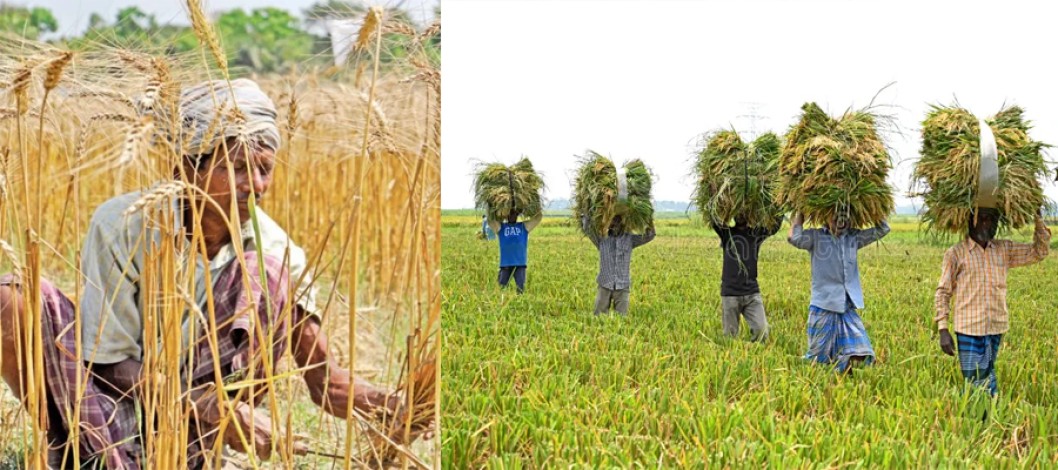
File photo
Despite the increasing risks of climate change, the necessary financing and services to increase the adaptive capacity of smallholder farmers to cope with its impacts are still limited. In addition to the lack of access to agricultural extension services, credit and insurance, the limitations in reaching climate finance at the local level are making it difficult for farmers to adapt.
This picture of climate adaptation of smallholder farmers in Bangladesh has emerged in the Asian Development Bank (ADB)’s ‘Technical Note-7 on the Community Resilience Partnership Program’. The report, based on Heifer International’s activities in Bangladesh, Cambodia and Nepal, highlights the role of women-led cooperatives in connecting farmers with finance, technology, insurance, markets and agricultural information at the local level.
According to the report, 133,034 smallholder farmers are being served through 101 cooperatives in Bangladesh. A total of 490 cooperatives in the three countries serve more than 351,000 smallholder farmers. More than 95 percent of the members of these cooperatives are women.
The report says that small farmers are facing risks such as rising temperatures, erratic rainfall, prolonged droughts, flash floods and soil degradation. At the same time, fragmented land, limited financing, infrastructure deficits and limited access to insurance and credit are creating obstacles to climate adaptation.
The report also mentions that less than 10 percent of global climate finance reaches the local level. As a result, reaching the necessary finance to local farmers and institutions that are at risk from climate change is still a big challenge.
Dr. Sharmin Nilormi, Professor of Economics at Jahangirnagar University, has been working on climate change and agriculture for a long time. When asked, she told Ittefaq, “Most of the farmers in our country are small farmers. Due to temperature change, challenges in terms of expenditure and adaptation in agriculture are increasing. In this situation, it is important to expand financing and agricultural credit on easy terms to increase the adaptation capacity of farmers. If climate adaptation is limited to short-term projects only, it is difficult to achieve the desired results in the long term. Coordination between local farmers' organizations, government institutions and financing agencies should be increased.
He also said that attention should also be paid to the quality of land; since many farmers lack skills, they are inexperienced in matters like pesticide application, a similar problem is also in agricultural technology. Everyone, including individuals and the government, has a role to play here. Our GDP in agriculture is about 12 percent. However, this sector has not been worked on in the same way for the development of farmers. However, the current government has taken several initiatives including agricultural loans and agricultural cards. In addition to implementing these, awareness and changes should be brought about among farmers.
Women's agricultural responsibilities are increasing, inequality is not decreasing: Due to climate change and migration of men from agriculture, more and more agricultural responsibilities are being transferred to women in many areas. But despite the increase in responsibilities, women are not getting equal opportunities in land ownership, credit, agricultural extension services and climate information, the report mentioned.
The report identified the limited reach of conventional agricultural extension services as a structural problem. It said that only about 5 percent of these services effectively reach women. In addition, weak coordination among institutions and the tendency for top-down planning are also hindering climate adaptation at the local level. Many initiatives are limited to short-term projects. Once the project ends, it becomes difficult to maintain continuity and scale up successful initiatives.
Cooperatives to overcome the gap in financing and services: Within these constraints, women-led cooperatives are being used as a platform to connect farmers with finance, technology, information and markets at the local level. 14 solar-powered irrigation pumps have been installed and managed in the country. In addition, an IoT-enabled fogging system (an automatic fog or fine water particle distribution system, which is operated using sensors and control technology connected via the internet) has been introduced at a cost of about $200, in which farmers are also participating in the investment. There is a provision to pay a maximum service fee of 10 percent to the cooperative for coordinating these systems, after-sales service, warranty and communication with suppliers.
As part of climate-resilient infrastructure, weather-resistant roofs have been installed in more than 200 farming families. According to the report, it includes a mechanism for returning funds through assistance and cooperatives in addition to the farmer's own funds.
Role of cooperatives in insurance and banking: Cooperatives are also being used to create insurance opportunities to address agricultural and animal husbandry risks. The report says that more than 150 farmers have come under livestock insurance. Farmers are paying money directly to the insurance company and are assisting in the process of cooperative registration, data verification and claim settlement. In this case, the cooperative is getting 10 percent commission.
On the other hand, 70 people have been trained as 'bank sathis', out of which 30 are actively helping farmers. They are helping farmers of more than 40 cooperatives with banking, loan applications, necessary documents and preparing business plans.
In Jessore, 66 people have been trained through the ‘Soil Doctor’ initiative. Each is assisting about 150 farmers in collecting soil samples, sending them to government laboratories and getting recommendations for fertilizer use.
Challenges in moving from projects to long-term systems: The report says that while there have been successful climate adaptation initiatives at the local level, scaling them up remains a challenge. Many successful initiatives fail to take shape into permanent structures due to short-term projects, limited geographical scope and weak inter-institutional coordination.
You can learn about South Asia's largest exhibition on this
topic through this link: http://graintechbd.com/
Source: Online/GFMM




















Comment Now