



Al Amin lives in Panthapath, Dhaka. He is not even forty years old. Yet he avoids sugar in his cup of tea. He said that he has reduced sugar to control his weight and to avoid diabetes. In the case of Mansur Alam of Chittagong, the matter is not a matter of choice, but of necessity. On the advice of a doctor, he has left out sugar in his tea. Before buying any food product from the market, he carefully checks whether it is sugar-free or not.
According to the data of the United States Department of Agriculture (USDA), sugar consumption in Bangladesh has decreased by about 33 percent during the five marketing seasons (May-April period) from 2021-22 to 2025-26. Among the major consuming countries, the rate of decrease in consumption during this period was the highest in Bangladesh. The organization has made this calculation based on sugar used for human consumption, including use in the food and beverage industry.
It is not just Al Amin and Mansur Alam. A silent change is taking place in dietary habits everywhere in the country, from cities to villages. Many people are reducing their intake of sugar and sugar-based foods. This change is also reflected in national and international statistics.
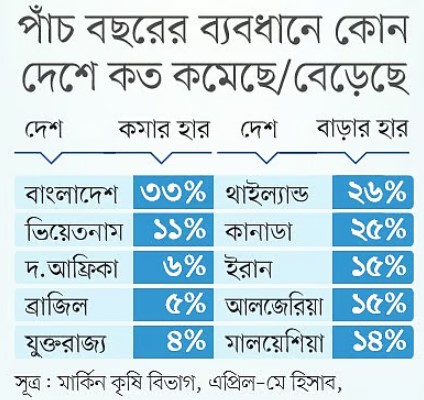
After Bangladesh, sugar consumption has decreased the most in Vietnam, by about 11 percent. At the same time, consumption has decreased by 6.40 percent in South Africa, 5.30 percent in Brazil, and 4 percent in the United Kingdom.
This trend in Bangladesh is contrary to the global picture. In the 2021-22 season, sugar consumption for human consumption in the world was about 174 million tons. In the November estimate for the 2025-26 season, it has increased to about 178 million tons. That is, although consumption in Bangladesh has decreased by about 33 percent, the world has increased by about 2.35 percent.
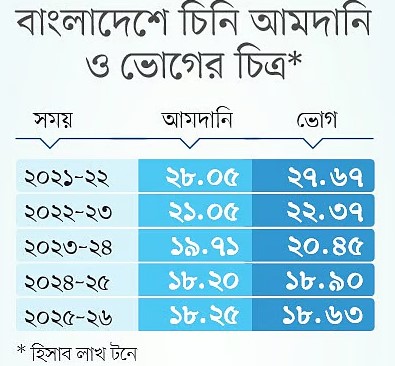
According to the organization's data, sugar consumption in Bangladesh was increasing until the Corona period. The trend started changing after the pandemic. For example, it decreased from 2.767 million tons in the 2021-22 season to 2.237 million tons in the next season. In the 2023-24 season, consumption was 2.045 million tons and in the 2024-25 season, it was 1.890 million tons. The USDA has estimated that it will further decrease to 1.863 million tons in the 2025-26 season.
Almost all the sugar used in Bangladesh is dependent on imports. The production of government sugar mills is very limited. According to the National Board of Revenue (NBR), the country imported a maximum of 2.525 million tons of sugar in the 2021-22 fiscal year. Imports have decreased by 2.1 million tons in the outgoing 2025-26 fiscal year. Of this, 1.863 million tons were unrefined sugar and 2.37 million tons were refined sugar.
There are some differences between the NBR's import data and the USDA's consumption data. This is due to imports under bond facilities, differences in fiscal year and marketing season, stockpiling and informal trade.
Direct sugar consumption is also decreasing
There is no latest data on how much sugar a person directly consumes in Bangladesh. However, the 2010 and 2016 surveys of the Bangladesh Bureau of Statistics (BBS) Household Income and Expenditure Survey contain information on daily sugar consumption per capita. According to the survey, in 2010, a person consumed an average of 7.40 grams of sugar per day. In 2016, it decreased to 6.40 grams. That is, the amount of direct sugar consumption per person has decreased by about 14 percent in a span of six years.
However, in the 2022 publication of the Household Income and Expenditure Survey, sugar, jaggery and sweets are shown together as one food group. The combined daily intake of these three per person is 16.40 grams. However, since information on sweets was not included separately in previous surveys, this information for 2022 cannot be directly compared with that of 2010 or 2016.
Although the latest data on sugar consumption is not available, an idea of per capita consumption can be obtained based on the total sugar consumption of the country. If the seasonal total sugar consumption data of Bangladesh published in the USDA report is divided by the World Bank's annual population, it can be seen that per capita sugar consumption in the 2021-22 season was 16.51 kg per year, or an average of 45.22 grams per day. In the following season, it came down to 13.21 kg or 36.18 grams. Then in the 2023-24 season, it was 11.93 kg (32.68 grams), in the 2024-25 season, it was 10.89 kg (29.83 grams) and in the 2025-26 season, it was 10.77 kg (29.50 grams). This also includes sugar used in the food industry, use in the hotel-restaurant sector and other parts of the supply chain.
Data from both sources indicate that the trend of sugar consumption and direct sugar consumption in the country is downward.
Imports of sugar alternative sucralose are increasing
Imports of sugar alternative sweetener sucralose are increasing rapidly. According to NBR data, 22,661 kg of sucralose was imported into the country in the 2021-22 fiscal year. In the next fiscal year, it increased to 40,102 kg. Imports increased further to 80,688 kg in the 2023-24 fiscal year. In the 2024-25 fiscal year, sucralose was imported to 90,750 kg. In the 2025-26 fiscal year, it has increased to 1 lakh 8 thousand 181 kg. That is, the import of sucralose has increased by about 377 percent or 4.8 times in five years.
Since sucralose is much sweeter than regular sugar, it can be used in small quantities. It is used in sugar-free or low-sugar biscuits, beverages, dairy products, medicines and various processed foods. As a result, the relevant people believe that the import of sucralose is also increasing with the expansion of the market for sugar-free and low-sugar food products.
Why is sugar consumption declining?
Talking to public health experts, businessmen and consumers, four main reasons for the decline in sugar consumption have emerged. The reasons are the spread of diabetes, increasing health awareness, high sugar prices and the spread of sugar-free or low-sugar products.
According to the International Diabetes Federation in 2015, at that time, the number of people with diabetes in Bangladesh was 7.1 million. The organization estimated that the number of people with diabetes in Bangladesh would reach 13.6 million by 2040.
The 2025 edition of the organization's Diabetes Atlas states that the number of people with diabetes in Bangladesh in 2024 will be 13.8 million. That is, the estimate made in 2015 for 2040 has already exceeded the estimate for 2024. In 2015, Bangladesh was in tenth place in the world in the number of people with diabetes. In 2024, the country rose to seventh place.
Although sugar alone is not solely responsible for diabetes, patients avoid sugar on the advice of doctors. As a result, doctors and businessmen believe that a large portion of the population is limiting sugar and sweet foods due to the large number of diabetic patients and the increasing awareness about the disease.
Secondly, despite the change in tea drinking habits, sugar consumption is decreasing. Shah Moinuddin Hasan, chairman of the Tea Traders Association of Bangladesh, said that people are now drinking more rang-cha than milk-cha. Many are drinking tea without sugar. This is not only reducing the consumption of tea leaves, but also reducing the consumption of sugar.
Thirdly, the increase in sugar prices in recent years has affected consumption. For example, in October 2022, the price of sugar in the retail market exceeded 100 taka per kg for the first time. Later, it increased to 150 taka at one stage. According to the Trading Corporation, sugar is now being sold at retail for 105 to 110 taka per kg. Economists say that even if income does not increase, when prices increase, people first reduce luxuries or discretionary consumption, and sugar falls into it.
Fourthly, earlier, the range of sugar-free or low-sugar processed foods was limited. A decade and a half ago, biscuit-type products were on the list of sugar-free foods. In the last few years, the sugar-free category has been expanded to all types of food products. Now, sugar-free products are being marketed in various categories including beverages, biscuits, coffee, desserts.
Kamruzzaman Kamal, director of PRAN-RFL, one of the country's largest food product manufacturing and marketing industrial groups, told, "The demand for sugar-free food products has been increasing very rapidly in the last few years. Due to this demand from health-conscious people, we have increased the supply of sugar-free or low-sugar food products."
What is the health and behavioral explanation?
Chittagong Medical College Principal Professor Mohammad Jasim Uddin told that sugar is usually absorbed quickly and can increase blood sugar levels in a short time. Regular excess sugar intake increases the risk of weight gain and metabolic diseases. For this reason, doctors, especially those at risk of diabetes and overweight, advise people to limit their sugar consumption.
Tuhin Biswas, assistant professor in the Department of Public Health at Asian University for Women, said that people can now learn about the risks of diabetes, high blood pressure and obesity from social media. This is leading to behavioral changes and people are reducing their sugar consumption.
No new investment in sugar processing industry
The decline in sugar demand has affected the industrial sector. Although there has been investment in six refining factories in the past two decades, only three industrial groups are active now—Meghna Group of Industries, City Group and Abdul Monem Sugar Refinery.
Meghna Group of Industries Chairman Mustafa Kamal told that the current demand can be met with the existing factories. Therefore, there is no need for new major investments in this sector.
The market is changing
Economists and businessmen believe that the time has not yet come to conclude that the sugar market will shrink at the same rate continuously. This is because the amount of imports, stocks and industrial use changes year by year. However, it is clear from the statistics that the old trend of rapid growth is changing. The size and nature of the market is changing along with health awareness, high prices, and the spread of low-sugar and sugar-free products.
You can learn about South Asia's
largest exhibition on this topic through this link: https://www.foodingreexpo.com/
Source: Online/GFMM



















Comment Now