




Photo: Collected
Land is the foundation of agrifood systems, supporting over 95 percent of food production while providing essential ecosystem services that sustain life on Earth. Yet increasing pressures are degrading this finite and essential resource, undermining its capacity to meet growing demands for more efficient, productive and sustainable agriculture.
Let's explore what land degradation is, where it is most prevalent, and the solutions that can help reverse the trend.
What is land degradation?
Land degradation refers to the persistent decline in land’s ability to sustain essential ecosystem functions and services. Driven largely by human activities such as deforestation, overgrazing and unsustainable farming, it erodes soil health, biodiversity and productivity.
Its impacts range from subtle yield losses to the complete abandonment of agricultural land, weakening the natural foundation on which food systems depend.
Land is finite and irreplaceable
Land underpins food security, livelihoods, biodiversity and climate regulation. But degradation is now a pervasive challenge in countries of all income levels.
Degradation affects all agricultural systems
In addition to croplands, degradation undermines livestock production in rangelands and – through forest loss driven by agricultural expansion – disrupts climate patterns and biodiversity. In fact, nearly 90 percent of global deforestation stems from agriculture, with cropland expansion and pasture creation the primary drivers.
1.7 billion people are affected
The reduction of crop yields caused by land degradation is a direct threat to global food security. About 1.7 billion people live in areas where historically accumulated land degradation is directly responsible for lower crop yields. Nearly 1 billion of them are in middle-income countries, which are most affected. In high-income countries, heavy use of fertilizers and other inputs keeps yields high, masking the damage to land and adding to environmental harm.
Farm size influences our ability to address land degradation
Of the world’s 570 million farms, 85% are smaller than 2 hectares and work only 9% of farmland, while the 0.1% of farms over 1,000 hectares control nearly half. Medium-sized farms are especially important in Africa and Asia, managing about half of all farmland there.
All farm sizes are crucial for food security
The viability of farms of all sizes is central to ensuring food security. Medium and large farms together supply most of the world’s kilocalories provided by crops. Smallholders produce less overall but are essential in low- and lower-middle-income countries, where they provide about 60% of the kilocalories provided by crops.
Land degradation requires a global response
The international community has recognized land degradation as a critical challenge, with over 130 countries committing to Land Degradation Neutrality under the United Nations Convention to Combat Desertification (UNCCD). The most prominent global commitment is enshrined in SDG Target 15.3, which calls on members to “combat desertification, restore degraded land and soil, and strive to achieve a land degradation-neutral world” by 2030. Achieving these goals and creating synergies with other SDGs requires avoiding, reducing and reversing land degradation while maintaining productivity.
Land degradation hotspots
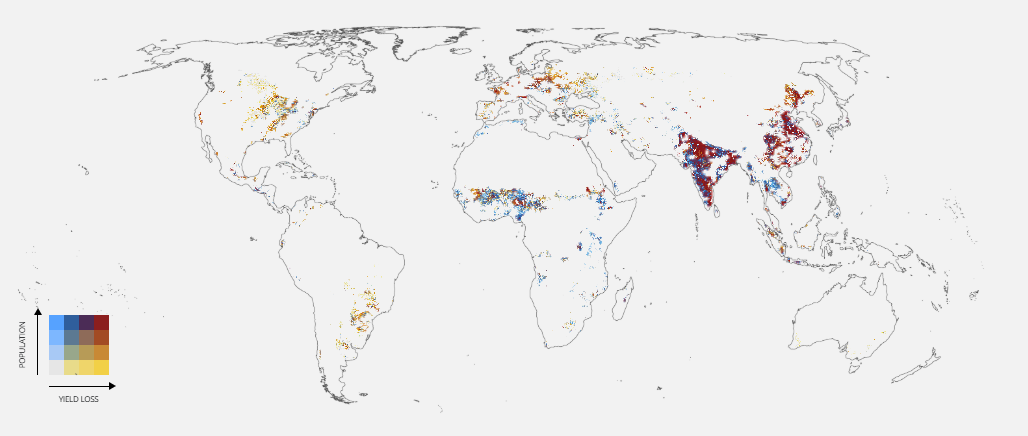
The largest populations experiencing yield gaps caused by human-induced land degradation reside Southern and Eastern Asia. These are regions that have accumulated a substantial degradation debt and also have high population densities.
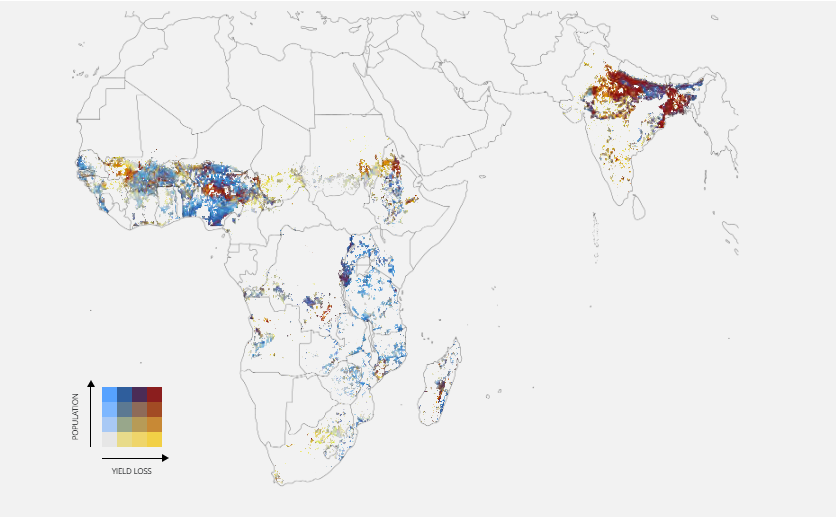
The maps below show the regions most affected by degradation-induced yield losses, which refer to the portion of yield gap directly attributable to land degradation due to human activity.
Population hotspots exposed to degradation-induced yield losses
Where land degradation meets poverty and food insecurity
When land degradation, poverty and hunger overlap, they create severe vulnerability hotspots. The most severe overlaps are found in northern India, Ethiopia, Madagascar and parts of West Africa. In these areas, exposed populations include 47 million children under five that suffer from stunting. These hotspots represent a convergence of environmental degradation and human deprivation that demands urgent and targeted responses.
How farm sizes shape our agrifood systems
Farm sizes vary enormously across the world, from tiny smallholdings to vast commercial operations. This diversity has big implications for food security and land management.
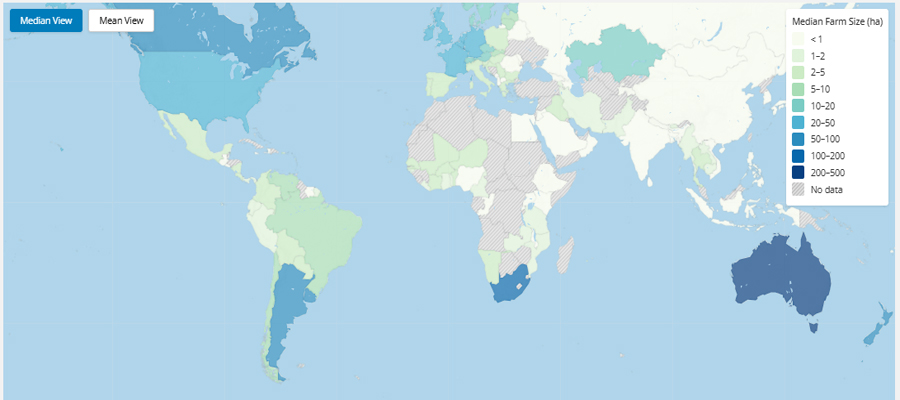
As we saw above, of the world’s 570 million farms, 85 percent are smaller than 2 hectares but cultivate just 9 percent of farmland, while only 0.1 percent of farms exceed 1,000 hectares yet manage half of all agricultural land.
The map below illustrates how farm size distributions differ by country, helping us understand both who produces our food and how responsibilities and vulnerabilities to land degradation are shared across scales. You can toggle between mean and median farm sizes to see these contrasts more clearly.
Farm size distributions and difference between mean and median farm sizes (in hectares)
You can learn about South Asia's largest exhibition on agricultural
topic through this link: http://graintechbd.com/
Source: Online/GFMM


















Comment Now