


File Photo
Palm oil production is important to the economy of Indonesia as the country is the world's biggest producer and consumer of the commodity, providing about half of the world's supply. In 2016, Indonesia produced over 34.6 million metric tons (34,100,000 long tons; 38,100,000 short tons) of palm oil, and exported 25.1 million metric tons (24,700,000 long tons; 27,700,000 short tons) of it. Oil palm plantations stretch across at least 12 million hectares (30 million acres). There are several different types of plantations, including small, privately owned plantations and larger, state-owned plantations. There are a variety of health, environmental, and societal impacts that result from the production of palm oil in Indonesia. A recent publication by the NGO Rainforest Action Network (RAN) indicates that the use of palm oil by some of the biggest chocolate and snack producers is increasing this problem.
In addition to servicing traditional markets, Indonesia is looking to put more effort into producing biodiesel. China and India are the major importers of palm oil, accounting for more than a third of global palm oil imports. Looking at Indonesia's GHG emissions breakdown, climate change mitigation will mainly come from controlling forest fires and peatland conservation. REDD+ (Reducing Emissions from Deforestation and Forest Degradation in Developing Countries) will be 'an important component of the NDC target from [the] land-use sector'.[4] This implies that there will need to be large economic incentives and inputs from outside resources to ensure that land is conserved.
Deforestation
As late as 1900, Indonesia was still a densely forested country: forests represented 84 percent of the total land area. Deforestation intensified in the 1970s and has accelerated further since then. The estimated forest cover of 170 million hectares (420 million acres) around 1900 decreased to less than 100 million hectares (250 million acres) by the end of the 20th century. Of the total logging in Indonesia, up to 80% is reported to be performed illegally.
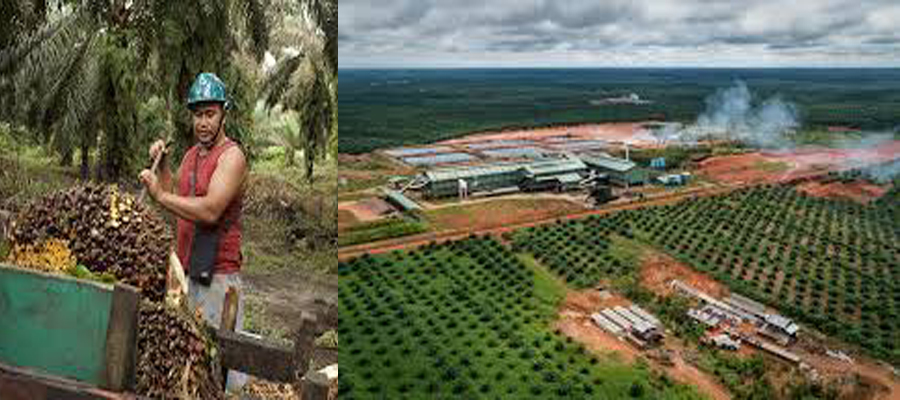
Forests are often cleared for the palm oil industry. Typically, the company that has usage rights for the land will contract individuals to burn the supposedly "degraded" forest, thereby avoiding direct responsibility for fires, which become more likely when peatland is deforested.
Forest fires often destroy high-capacity carbon sinks, including old-growth rainforest and peatlands. In May 2011, Indonesia declared a moratorium on new logging contracts to help combat this. This appeared to be ineffective in the short-term, as the rate of deforestation continued to increase. By 2012, Indonesia had surpassed the rate of deforestation in Brazil and become the fastest forest-clearing nation in the world. However, it is unclear about the current comparative deforestation rates between Indonesia and Brazil because new political leadership in Brazil has recently increased deforestation dramatically.[citation needed]
Domestically, there has been some effort to crack down on illegal slash-and-burn practices. A Peatland Restoration Agency was also formed in 2015 under President Joko Widodo. In 2018, the government no longer granted licenses for deforestation for palm oil plantations. It is unclear as to how effective these laws are due to corruption, poor enforcement, and loopholes in some of these policies.
Production
Production of palm oil in Indonesia has, since 1964, recorded a phenomenal increase from 157,000 metric tons (155,000 long tons; 173,000 short tons) to 41.5 million metric tons (40,800,000 long tons; 45,700,000 short tons) in 2018 and a total of 51 million metric tons (50,000,000 long tons; 56,000,000 short tons) will be needed in 2025 to sustain international and domestic demands.[8] Palm oil accounts for 11% of Indonesia's export earnings of $5.7bn. Maintaining its status as the world's largest producer of palm oil, Indonesia has projected a figure of 40 million metric tons (39,000,000 long tons; 44,000,000 short tons) by 2020. In this context, the global production figure given by the Food and Agriculture Organization (FAO) was 50 million metric tons (49,000,000 long tons; 55,000,000 short tons) for 2012, equivalent to double the 2002 production. This increase is also reflected in increases of Indonesia's production of palm oil for the same period, from 10.300 million metric tons (10,137,000 long tons; 11,354,000 short tons) in 2002 and 28.50 million metric tons (28,050,000 long tons; 31,420,000 short tons) in 2012. In April 2022, President Joko Widodo announced that the country would effectively ban palm oil exports starting 28 April, until further notice. The policy is said to guarantee the availability of affordable cooking oil in the domestic market. In return, this has flustered global markets and sent the commodity's price to historic highs.
See Also: https://oilfatbd.com/
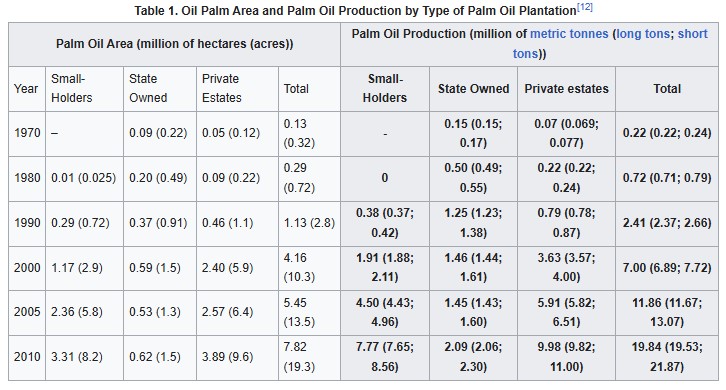
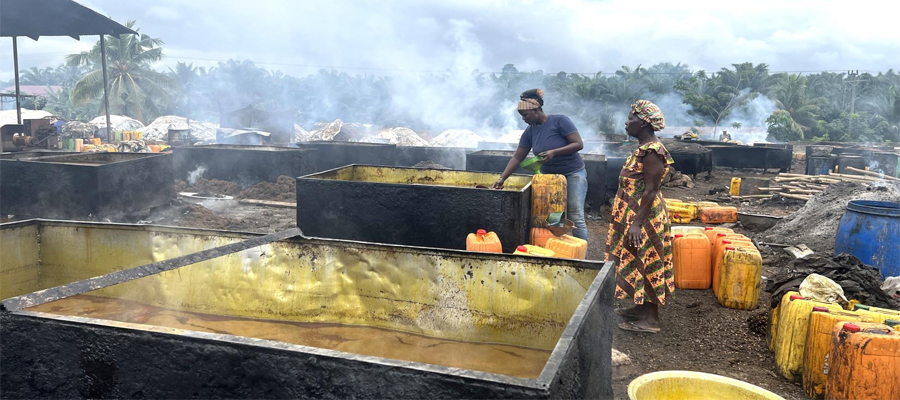
The entire oil production is derived from Indonesia's rainforest, which ranks third in the world, the other two being in the Amazon and Congo basins. The three main business models for palm oil production in Indonesia are private large-scale plantations, nucleus estate smallholders, and independent smallholders. The breakdown of palm oil area and production by type of palm oil plantation is shown in Table 1. Palm trees that were planted about 25 years ago have an annual average production rate of 4 metric tons per hectare of oil (1.6 long tons/acre; 1.8 short tons/acre). Indonesia is considering plans to increase production by introducing newer varieties, which could double the production rate per hectare (acre).
Borneo and Sumatra are the two islands that account for 96% of Indonesia's palm oil production.[13] As of 2011, there were 7.8 million hectares (19 million acres) of palm oil plantations, with 6.1 million hectares (15 million acres) of these being productive plantations under harvest, thus making Indonesia the global leader in crude palm oil (CPO) production. According to World Bank reports, nearly 50% of CPO produced in the country is exported in an unprocessed form, while the remaining is processed into cooking oil, about half of which is exported, while the rest is consumed locally.[14] The unprocessed CPO is exported to Pasir Gudang in Johor, Malaysia, before the refined palm oil and palm kernel oil are exported worldwide.
Uses
Palm oil is an essential ingredient for the food industry, used as a cooking oil or in the production of processed foods (such as many types of chocolates, biscuits, chewing gum...) and for the manufacture of cosmetic and hygiene products (soaps, lipstick, washing powder...). It is also valuable as a lubricant in industrial production or for the energy sector for the production of biodiesel.
Biofuel
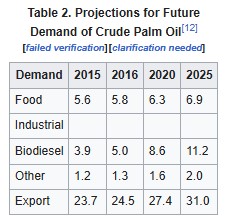 Over the past few years, an interest in biofuel has increased as a potential clean energy source; it has become a primary use for domestic crude palm oil. As seen in the table 2, domestic use of biodiesel is expected to see the most growth of 7.3% by 2025. The Indonesian government has been interested in growing biofuel plantations to decrease the country's reliance on fossil fuels.[12] It is predicted that in 2025, biofuel will account for 25% of Indonesia's national energy mix.
Biodiesel is created using a transesterification process that converts the triglycerides in the crude palm oil into esters to be used in biofuel production. This process has been shown to have a biodiesel yield of 93.6%.
The crude palm oil production system is vital to the economy of Indonesia and has many domestic and foreign uses. It provides a major export source through food and for industrial use. It is also used for domestic food, biodiesel, and biofuel. It is estimated that the population of Indonesia will grow to 285 million people in 2025, which will lead to an increased domestic demand for vegetable oil. In addition, other domestic industrial uses of palm oil are to support the pharmaceutical, cosmetic, and chemical industries.
Companies
Major local and global companies are building mills and refineries, including PT Astra Agro Lestari Terbuka (150,000 metric tons per year (150,000 long tons per year; 170,000 short tons per year) biodiesel refinery), PT Bakrie Group (a biodiesel factory and new plantations), and Surya Dumai Group (biodiesel refinery).
Cargill (sometimes operating through CTP Holdings of Singapore) is building new refineries and mills in Malaysia and Indonesia, expanding its Rotterdam refinery to handle 300,000 metric tons (300,000 long tons; 330,000 short tons)/year of palm oil, and acquiring plantations in Sumatra, Kalimantan, and Papua New Guinea.
Robert Kuok's Wilmar International Limited has plantations and 25 refineries across Indonesia to supply feedstock to the new biodiesel refineries of Singapore, Riau, Indonesia, and Rotterdam.
Musim Mas Group has plantations and refineries in Malaysia and Indonesia – Kalimantan, Medan, etc., although they are headquartered in Singapore. Marihat Research Station (MRS), nowadays known as RISPA and located in Medan, is the first research centre for Palm Oil Plantation in Indonesia. One of its well-known experts in soil, who has now retired, was Ir. Petrus Purba.
In August 2011, the governor of Aceh issued a permit for Indonesian palm oil firm PT Kallista Alam to develop around 1,600 hectares (4,000 acres) in Tripa. Indonesian palm oil producer Triputra Agro Persada will reportedly increase its planted area by about two-thirds from 2013 to 2015. See more.
Source: Online/GFMM


















Comment Now